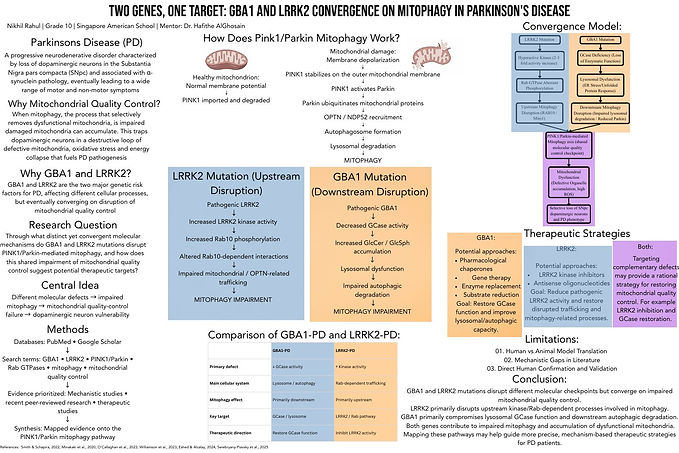
Upstream and Downstream Convergence: How do the GBA1 and LRRK2 genes disrupt PINK1/Parkin-Mediated Mitophagy?
Nikhil Rahul
Singapore American School
Parkinson’s Disease (PD) is a complex progressive neurodegenerative disease with certain cases exhibiting non-idiopathic forms. Understanding this allows for a better understanding about the disease and treatment options. The 2 main genetic forms of PD are mutations in the Glucosylceramidase Beta 1 (GBA1) and Leucine-Rich Repeat Kinase 2 (LRRK2) genes. GBA1 and LRRK2 gene mutations disrupt mitophagy through distinct mechanisms that converge on PINK1/Parkin-linked mitochondrial quality control in PD. GBA1 mutations impair lysosomal enzyme glucocerebrosidase (GCase), causing toxic substance accumulation and an aggressive phenotype of early motor declining and severe non-motor symptoms. Pathogenic LRRK2 mutations induce a toxic gain of function by hyperactivating kinase activity, significantly increasing phosphorylation of downstream Rab GTPases and disrupting vital endolysosomal trafficking. This impairs mitophagy and clearance of misfolded proteins, ultimately driving neurodegeneration of dopaminergic neurons. While standard scientific literature traditionally examines these genetic pathways in isolation, they can synergistically disrupt mitophagy and lysosomal pathways causing PD. A joint review is also critical especially as dual-inhibitor clinical trials emerge and multi-mutation carriers present uniquely altered phenotypes. This review establishes a convergence model, where GBA1 and LRRK2 mutations disrupt different checkpoints of the PINK1/Parkin mitophagy axis, but converge on the common collapse of mitochondrial quality control that creates both genotype-specific and shared therapeutic targets.