The Role of School Vouchers in Four Year College-Going Rates of Private High Schools
Dannah Barajas Caballero
American High School
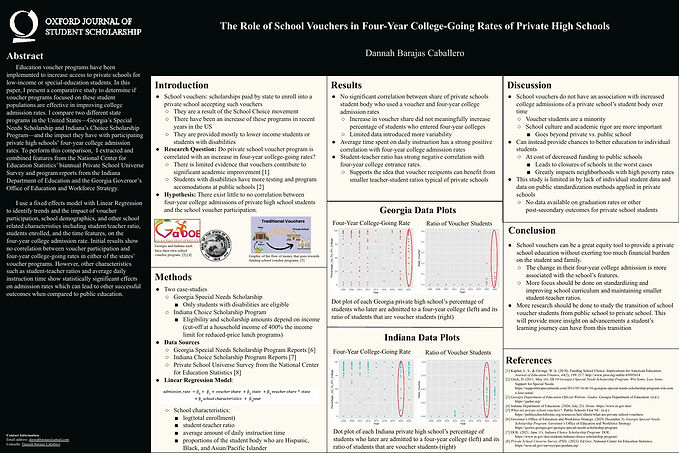
Education voucher programs have been implemented to increase access to private schools for low-income or special-education students. In this paper, I present a comparative study to determine if voucher programs focused on these student populations are effective in improving college admission rates. I compare two different state programs in the United States—Georgia’s Special Needs Scholarship and Indiana’s Choice Scholarship Program—and the impact they have with participating private high schools’ four-year college admission rates. To perform this comparison, I extracted and combined features from the National Center for Education Statistics’ biannual Private School Universe Survey and program reports from the Indiana Department of Education and the Georgia Governor’s Office of Education and Workforce Strategy. I use a fixed effects model with Linear Regression to identify trends and the impact of voucher participation, school demographics, and other school related characteristics including student/teacher ratio, students enrolled, and the time features, on the four-year college admission rate. Initial results show no correlation between voucher participation and four-year college-going rates in either of the states’ voucher programs. However, other characteristics such as student-teacher ratios and average daily instruction time show statistically significant effects on admission rates which can lead to other successful outcomes when compared to public education.